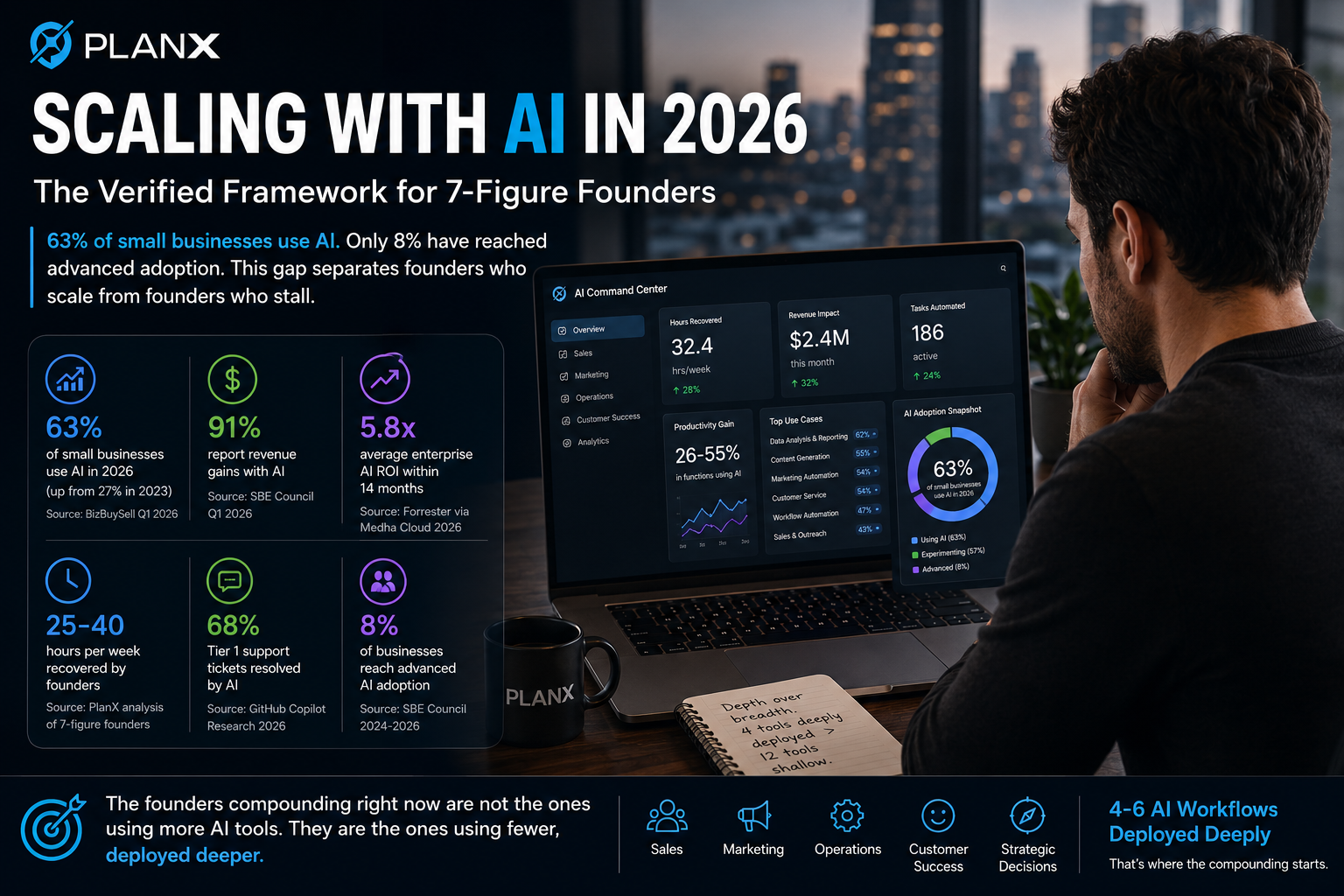
63% of small businesses now use AI. Only 8% have reached advanced adoption. This gap separates founders who scale from founders who stall. Here’s the verified 2026 framework for what actually works.
| Written by the PlanX team • Last updated: May 2026 • Reviewed for accuracy: May 2026
Sources cited: BizBuySell Q1 2026 Insight Report, SBE Council Q1 2026, Stealth Agents 2026 AI Adoption Report, Gartner 2026 Predictions, Forrester via Medha Cloud 2026 |
| QUICK ANSWER
Scaling with AI in 2026 means deploying AI workflows systematically across sales, marketing, operations, customer success, and strategic decisions. Verified 2026 data: 63% of small businesses use AI (up from 27% in 2023), 91% report revenue gains, but only 8% reach advanced adoption. Founders past $1M ARR who deploy 4-6 AI workflows properly typically recover 25-40 hours per week, improve sales conversion 15-30%, and multiply content reach 5-8x within 6 months. The key is depth over breadth: 4 tools deployed deeply beats 12 tools deployed shallow. |
| AI Adoption for Founders 2026: Key Facts
• Small business AI adoption rate: 63% (BizBuySell Q1 2026 Insight Report) • Performance gains reported: 83% of AI adopters (BizBuySell Q1 2026) • Revenue boost reported: 91% of AI users (SBE Council Q1 2026) • Plan to continue investing: 93% (SBE Council Q1 2026) • Reach advanced AI adoption: only 8% (SBE Council 2024-2026) • Still in experimentation mode: 57% (March 2026 research) • Provide no AI training: 70% of employers (March 2026 research) • Have unstructured data (AI readiness gap): 67% (March 2026 research) • Productivity gains where AI deployed: 26-55% (Stealth Agents 2026) • Average enterprise AI ROI: 5.8x within 14 months (Forrester via Medha Cloud 2026) • Marketers save weekly with AI: 5+ hours (March 2026 research roundup) • Chatbots resolving Tier 1 tickets: 68% (GitHub Copilot Research via Medha Cloud) |
 The founders compounding right now are not the ones using more AI tools. They are the ones using fewer, deployed deeper.
In 2026, AI adoption among small businesses crossed a threshold that changes everything. 63% of small businesses now use AI in some capacity. Of those, 91% say it’s boosting their revenue. 93% plan to keep investing.
But here’s the number nobody talks about: only 8% of businesses have reached what researchers call “advanced AI adoption.” The other 55% are running AI tools without a strategy, calling it transformation.
This gap is what separates founders compounding past $1M and into 8-figure territory from founders stuck at the same revenue ceiling they hit two years ago. Not the AI tools themselves. The depth of deployment.
This guide is for founders already operating at 6 to 7 figures who want to know what actually works in 2026. Not the 50-tool listicles. Not the “AI will replace you” doom-scroll content. The honest framework for using AI to scale your business when the easy gains are already taken by the early adopters.
We’ve watched this play out across the PlanX community over the past 24 months. Founders running real businesses, deploying real AI, with real results. What follows is what the top operators are doing in 2026, what’s failing, and how to position yourself for the next 18 months as the gap widens.
| Where is AI actually blocked in your business?
Most founders deploying AI run into the same 3 to 4 bottlenecks within the first 90 days. The 2-minute Founder Bottleneck Quiz tells you exactly where yours will be, before you waste $20K on the wrong tool stack. Built specifically for founders past their first $1M. |
What is the state of AI adoption for founders in 2026?
AI adoption among small businesses reached 63% in 2026, up from 27% in 2023, according to the BizBuySell Q1 2026 Insight Report. Of those adopters, 91% report measurable revenue gains and 93% plan to continue investing. However, only 8% of businesses have reached what researchers call “advanced AI adoption.” The remaining 92% are running AI tools without systematic strategy, which is where the competitive divide is opening up in 2026.
| 63%
Of small businesses now use AI in 2026, up from 27% in 2023 Source: BizBuySell Q1 2026 Insight Report |
What founders are actually doing with AI in 2026
The latest BizBuySell Q1 2026 Insight Report shows 63% of small businesses use AI, with 83% reporting performance gains. The top use cases:
- Data analysis and reporting (62%): Faster forecasting, automated dashboards, real-time insights. The most common entry point.
- Content generation (55%): Emails, social posts, marketing copy, product descriptions. The fastest-deployed category.
- Marketing automation (54%): Email sequences, ad copy, audience segmentation. Strongest ROI in the first 90 days.
- Customer service (54%): Chatbots resolving 68% of Tier 1 tickets without escalation.
- Workflow automation (47%): Connecting tools, removing manual steps, building agentic workflows.
- Sales (43%): Lead scoring, outreach personalization, CRM augmentation.
What the adoption numbers don’t tell you
The same research shows 57% of small businesses are still in “experimentation mode” rather than systematic adoption. 67% have data that isn’t structured for AI use. 70% of employers provide no AI training. Only 8% reach advanced adoption.
Translation: most founders running AI tools right now are getting maybe 20% of the available ROI. The compounding starts when you move from experimentation to systematic deployment. That’s where 2026’s competitive divide is opening up.
| The productivity gap is measurable
AI-using companies report 26 to 55% productivity gains in functions where AI is deployed. AI marketers save 5+ hours per week (equivalent to more than a month of work per year). AI-augmented virtual assistants handle 3 to 5x the task volume of non-AI assistants at the same cost. This is not theoretical. This is what’s happening in the businesses outpacing yours right now. |
What are the 5 highest-ROI AI use cases for 7-figure founders?
Not every AI use case produces meaningful ROI for founders past their first million. These five do. Ranked by speed-to-impact: sales pipeline acceleration (fastest, 30-60 day ROI), marketing content compounding, operational workflow automation, customer success and retention, and strategic decision support (highest leverage, most underdeployed).
1. Sales pipeline acceleration (fastest ROI)
AI applied to your sales pipeline produces measurable returns in 30 to 60 days. Three layers:
- Lead scoring and qualification: AI models trained on your historical data identify which inbound leads are worth pursuing. Founders report 25 to 40% improvement in sales team focus on high-probability deals.
- Personalized outreach at scale: AI-assisted sequencing tools customize messaging based on prospect signals. Reply rates typically improve 2x to 3x compared to generic templates.
- Conversation intelligence: Tools that record, transcribe, and analyze sales calls. They flag what closed, what didn’t, and why. Compounds team learning across hires.
Why this works: sales has clean, measurable, attributable outcomes. AI deployed here pays back inside one quarter.
2. Marketing content compounding
AI for content isn’t about replacing your marketing team. It’s about turning every piece of content into 8 to 12 pieces across formats.
Real example pattern: one founder in our community converts every blog post (written by an AI-assisted human) into a LinkedIn article, three X threads, a YouTube short script, an email newsletter, two podcast talking-point briefs, and an SEO-optimized landing page variant. Single human input. AI-driven distribution. 8x reach with the same team.
The math: marketing teams using AI report 39% revenue impact tied to AI-augmented marketing workflows. Most of that comes from compounding distribution, not from AI “writing” content.
3. Operational workflow automation
This is the leverage layer. AI agents and automation tools that handle the operational glue that consumes founder time.
For 7-figure founders, the highest-ROI workflows are: invoice/contract processing, customer onboarding sequences, internal communication routing, project status updates, and reporting automation. Each saves 4 to 8 hours per week. Stack 5 to 7 of them and you’ve returned a full day per week of founder time. For deeper tactical implementation, see our AI Workflows for Founders guide.
4. Customer success and retention
AI deployed in customer success has the highest LTV impact of any use case. Three patterns we see consistently:
- Proactive churn detection (AI models predicting which customers are at risk based on usage patterns, then triggering retention workflows)
- Personalized onboarding paths (AI routing new customers through the playbook most likely to convert them into power users)
- Sentiment monitoring on support tickets and reviews (AI flagging issues before they show up in NPS surveys)
The reason this is on the list: retention compounds. A 5% improvement in retention is often worth more than a 25% improvement in new customer acquisition for businesses past $1M ARR.
5. Strategic decision support
This is the use case most founders are NOT using AI for in 2026. And it’s where the biggest competitive divide is opening up.
Founders compounding fast are using AI for: pricing analysis, market opportunity sizing, competitive positioning assessments, hiring decision support, partnership evaluation, and capital allocation modeling. Not as a replacement for judgment. As an input that compresses the analysis time from weeks to days.
Most founders treat AI as a productivity tool for executing decisions. The leverage is using AI to make better decisions before you execute. Different category entirely.
Comparison: AI for execution vs AI for strategy
Most founders use AI to execute tasks faster. The leverage is using AI to make better decisions before you execute. Here’s the side-by-side:
| Dimension | AI for Execution (most founders) | AI for Strategy (8% adopters) |
| Primary use | Generate content, draft emails, summarize meetings | Analyze pricing, evaluate partnerships, model capital allocation |
| Time saved | 5-10 hours/week per founder | Compresses analysis from weeks to days |
| ROI timeline | 30-60 days | 6-12 months (compounds over years) |
| Tool examples 2026 | ChatGPT, Jasper, Otter.ai, Fathom | Claude, ChatGPT Pro, Perplexity Pro, Gemini Deep Research |
| Adoption rate | 55%+ of small businesses | Less than 10% |
| Compounding effect | Linear time savings | Better decisions over time |
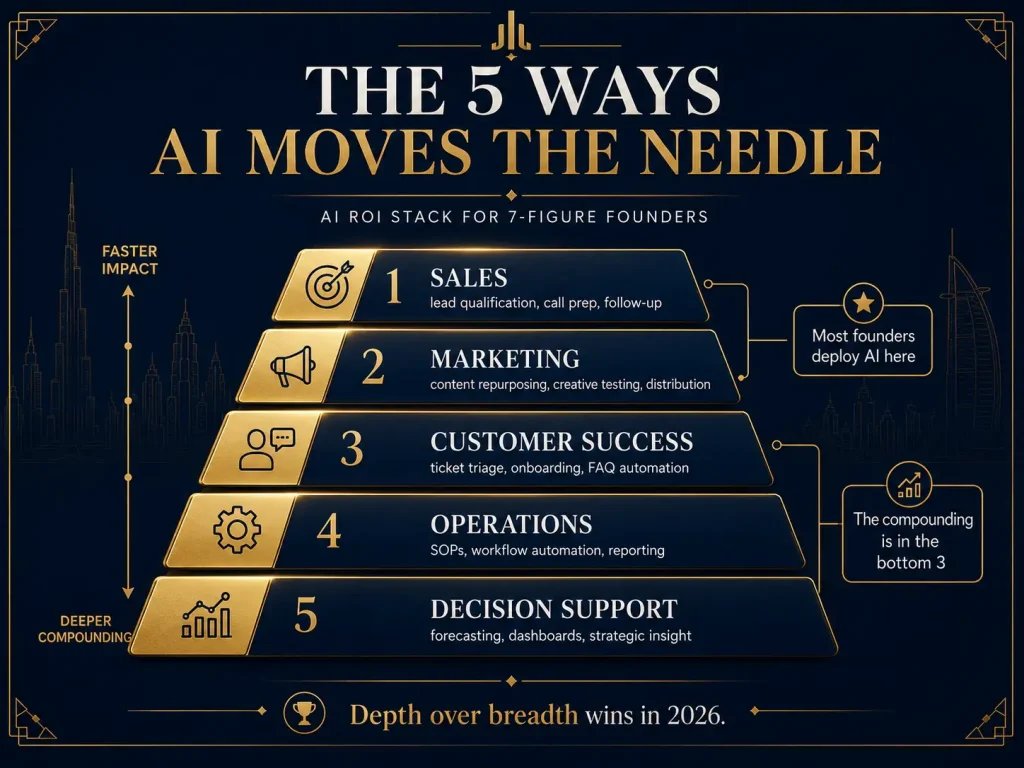 Most founders deploy AI in the top 2 layers. The compounding is in the bottom 3.
Why do most founders fail with AI implementation?
Most founders fail with AI for five specific reasons: tool sprawl without strategy, treating AI as a content generator only, deploying AI on messy data, fully automating without human checkpoints, and skipping team training. These patterns are predictable and preventable.
Failure 1: Tool sprawl without strategy
Average small business now uses a median of 5 AI tools. The top performers use fewer and deploy deeper. A founder running 12 disconnected AI tools is worse off than a founder running 4 integrated ones, even if the 12-tool founder spent more money.
The fix: pick 3 to 5 core tools that integrate with each other and your existing stack. Master those before adding the sixth.
Failure 2: Treating AI as a content generator only
If your AI use is 80% content production and 20% everything else, you’re getting maybe 20% of the available ROI. Content is the easiest entry point but the lowest-leverage application past a certain scale.
The fix: deliberately deploy AI in operational, sales, and decision-support functions. The compounding happens in these less-obvious applications.
Failure 3: Data that AI can’t use
67% of businesses have data that isn’t structured for AI use. Customer records in three different CRMs. Sales data scattered across spreadsheets. Operational metrics tracked manually.
AI cannot generate insights from messy data. Before deploying AI for analysis or decision support, you need to consolidate your data into something AI can actually read. This is unglamorous work but it’s the difference between AI working for you and AI generating plausible-sounding garbage.
Failure 4: No human in the loop on high-stakes outputs
AI is excellent at handling 80% of tasks 99% of the way. It’s terrible at handling the last 20% or the last 1%. Founders who automate fully without human review on customer-facing outputs, contracts, and strategic decisions get burned within 6 months.
The fix: AI handles volume, humans handle judgment. This is not changing in 2026 regardless of what model upgrades suggest.
Failure 5: No team training
70% of employers provide no AI training. Then they wonder why their team isn’t producing AI-augmented results. AI tools without trained operators are expensive shelfware.
The fix: budget 4 to 8 hours per quarter per team member on AI-specific skill building. Make it part of weekly operations, not a one-time onboarding.
How does AI map to the PlanX founder framework?
At PlanX, we organize founder scaling around 3 tracks: Growth, Leverage, Network. AI deployment maps cleanly to each track. Founders who win at scaling-with-AI address all three.
Growth track: AI for revenue acceleration
This is where AI directly compounds revenue. Sales pipeline acceleration, marketing content distribution, customer success retention, pricing optimization.
Question to ask: where in my funnel is conversion currently capped by human capacity? Wherever the bottleneck is, AI applied directly to that constraint produces the fastest revenue impact.
Leverage track: AI for operational scale
This is where AI removes founder time from the business. Workflow automation, agentic processes, internal communications routing, reporting automation, customer onboarding sequencing.
Question to ask: what 5 tasks consume the most founder/leadership team hours each week? Each one is a candidate for AI-driven systemization.
For specific tactical workflows we see in the PlanX community, see AI Workflows for Founders and AI Marketing Automation Guide.
Network track: AI for relationship and decision quality
This is the highest-leverage and least-deployed category in 2026. AI applied to: meeting intelligence, follow-up automation, partnership evaluation, hiring decision support, advisor and investor outreach personalization.
Question to ask: what conversations and relationships would improve my business if I had perfect recall, full context, and intelligent follow-up? AI deployed in the relationship layer produces non-obvious compounding effects.
Most founders neglect this track because it’s harder to measure than sales or marketing. But the ones using AI to systematize relationship intelligence are quietly building moats their competitors don’t see.
| Which track is your actual bottleneck?
Most founders think they have a Growth problem when they actually have a Leverage problem. Or vice versa. The 2-minute Bottleneck Quiz diagnoses where AI deployment will pay back fastest in YOUR specific situation. |
What is the 90-day roadmap for scaling with AI?
The 90-day AI scaling roadmap has three phases: diagnose without deploying (days 1-15), deploy one workflow and prove ROI (days 16-45), then stack 2-3 more workflows that integrate with your initial deployment (days 46-90). Properly implemented, this typically returns 10-20 hours of founder time per week, improves sales pipeline conversion 15-30%, and reduces customer onboarding time by 40-60%.
Days 1 to 15: Diagnose, don’t deploy
The biggest mistake founders make is starting with a tool. Start with a diagnosis.
- Map your top 3 revenue bottlenecks (where does growth stall today?)
- Map your top 3 operational bottlenecks (where does YOUR time get consumed?)
- Audit existing data infrastructure (can AI actually read your customer/sales/financial data?)
- Identify the 1 to 2 highest-leverage AI applications based on bottlenecks, not on tool popularity
Output: a written prioritization document. Not a tool subscription.
Days 16 to 45: Deploy one workflow, prove ROI
Pick ONE workflow from your prioritization. Just one. Implement it properly. Measure baseline performance, deploy AI, measure post-deployment performance.
Common winners: AI-assisted email response automation (saves 6 to 12 hours per week), AI lead scoring on inbound prospects (improves sales team focus 25 to 40%), AI meeting notes with action item routing (compresses post-meeting admin from hours to minutes).
Output: one workflow producing measurable ROI you can defend with data.
Days 46 to 75: Stack 2 to 3 more workflows
Now that you have a winning pattern, deploy 2 to 3 more. Don’t go to 10. Stack the ones that integrate with your initial deployment so they compound.
Example stack: AI lead scoring → AI personalized outreach → AI meeting intelligence → AI follow-up automation. Each layer reinforces the others. Total founder time saved typically: 12 to 18 hours per week.
Days 76 to 90: Train the team, document the system
Don’t move to the next set of workflows until your team is using these consistently and you’ve documented the system. Otherwise you’re building shelfware faster than you can deploy it.
Output: 3 to 4 AI-augmented workflows running consistently across the team, documented SOPs, measurable ROI per workflow. Foundation for the next 90-day cycle.
| Realistic outcome by Day 90
Properly implemented, this 90-day approach typically returns 10 to 20 hours of founder time per week, improves sales pipeline conversion 15 to 30%, and reduces customer onboarding time by 40 to 60%. Total ROI compounds over the following 6 months as workflows mature and team adoption deepens. |
Frequently Asked Questions
What’s the single highest-ROI AI use case for a 7-figure founder in 2026?
Sales pipeline acceleration. Specifically: AI lead scoring on inbound prospects + AI-personalized outreach + AI conversation intelligence. This combination typically produces measurable revenue impact in 30 to 60 days because the inputs and outputs are clean, attributable, and tied directly to revenue. Marketing AI is faster to deploy but harder to attribute. Operations AI saves time but doesn’t directly compound revenue.
How much should a founder budget for AI tools at the 7-figure level?
Most founders we work with at $1M to $5M ARR spend $500 to $2,500 per month on AI tools total. Above $5M ARR, it scales to $2,500 to $8,000 per month. The bigger investment is implementation: budget AED 20,000 to AED 50,000 (USD 5,500 to USD 14,000) for proper setup if you bring in implementation help, less if you DIY. The wrong question is “how much should I spend?” The right question is “what’s the ROI per dollar deployed?”
What AI tools should founders actually use in 2026?
Depends entirely on your bottleneck. For sales: Apollo or Clay for AI-augmented outreach, Gong or Avoma for conversation intelligence, Salesforce Einstein or HubSpot AI for native CRM AI. For marketing: Jasper or Copy.ai for content, Mutiny for AI-driven personalization, HubSpot for marketing automation. For ops: Zapier with AI actions, Make.com, or n8n for self-hosted. For decision support: Claude, ChatGPT (Team or Enterprise), and Perplexity Pro at a minimum. The tools change. The framework of matching tools to bottlenecks doesn’t.
Is AI going to replace founders?
No. AI replaces specific tasks. Founders combine judgment, relationship management, vision-setting, and capital allocation in ways that AI doesn’t approach in 2026 and won’t approach in the foreseeable future. AI absolutely replaces tasks that founders should never have been doing manually in the first place: admin, basic content production, low-stakes communication, data entry, routine reporting. Founders who outsource these to AI free up time for the work AI cannot do.
How do I know if my business is ready for advanced AI deployment?
Three readiness checks. First: is your data clean and accessible? If your customer records are scattered across 3 systems and your sales data lives in spreadsheets, AI will produce garbage. Fix data first. Second: do you have stable, repeatable processes? AI accelerates whatever you point it at. If your processes are chaos, AI accelerates the chaos. Third: do you have someone (you or a team member) accountable for AI implementation and measurement? AI projects without an owner become shelfware. If you don’t have all three, work on the missing one before adding more AI tools.
Should I hire an AI consultant or do this in-house?
Depends on your stage and the complexity of your deployment. For founders at $1M to $3M ARR doing standard sales/marketing/ops AI, in-house with founder oversight is typically sufficient. For founders at $3M+ doing custom AI workflows, multi-tool integration, or AI agents handling sensitive business logic, an AI implementation consultant is worth $5K to $25K of project work. The ROI on good consulting at this scale is typically 5x to 10x within 90 days. Bad consulting is worse than no consulting. Vet aggressively, ask for references, demand to see actual deployed implementations.
What’s the difference between using AI tools and scaling with AI?
Using AI tools means deploying ChatGPT, Jasper, or similar tools for individual tasks. Saves time. Useful. Not transformational. Scaling with AI means redesigning how your business operates so that AI handles entire workflows, not just individual tasks. Sales pipeline runs on AI scoring + AI outreach + AI follow-up. Customer onboarding runs on AI sequencing + AI personalization. Reporting runs on AI dashboards + AI insight generation. This is the difference between 8% of businesses (advanced adopters) and the other 92%.
How do I avoid getting fooled by AI hype and shiny new tools?
Three filters. First: does this tool address a specific bottleneck I identified in my diagnosis? If not, skip. Second: can this tool integrate with my existing stack? Standalone tools rarely compound. Third: can I see 3 to 5 case studies from businesses at my scale showing measurable ROI? Hype tools have testimonials. Real tools have data. If a vendor can’t show you the data, they don’t have the data.
My team is resistant to AI. How do I get them to adopt it?
Two strategies that work. First: position AI as a leverage tool, not a replacement tool. Show team members specifically how AI handles their lowest-value tasks so they can focus on higher-value work. Compensation typically follows. Second: invest in actual training. Budget 4 to 8 hours per quarter per team member on AI skill building. Most resistance comes from “I don’t know how to use this and I look incompetent trying.” Training removes that. The companies whose teams adopt AI fastest are the ones that invest in teaching, not the ones that mandate use.
When should I attend an AI conference versus just reading content like this?
Reading content like this teaches you frameworks. Conferences compress 6 to 12 months of relationship-building, vendor evaluation, and tactical learning into 2 days. The math: a 1-hour conversation with a founder who solved your exact AI implementation problem 12 months ago is worth more than 50 hours of reading. Conferences are how you find those founders. PlanX 2026 specifically pairs founders working at the 6 to 7 figure scale with the tax structurers, AI implementation specialists, and operators who’ve done what you’re trying to do.
What’s the most underrated AI use case for founders in 2026?
AI for strategic decision support. Most founders use AI to execute decisions faster. The leverage is using AI to make better decisions before you execute. Apply AI to pricing analysis, market sizing, competitive positioning, hiring decisions, partnership evaluation, capital allocation. Compresses analysis time from weeks to days and reduces the cost of being wrong about important decisions. This is the use case where the most underdeployed value sits in 2026.
How do I know if my AI investment is working?
Three measures. Measure 1: hours saved per week (operational use cases). Track this honestly. Measure 2: revenue impact (sales and marketing use cases). Tag deals influenced by AI tools in your CRM and measure conversion vs non-AI-influenced baseline. Measure 3: quality of decisions (strategic use cases). Harder to measure but track decisions made with AI inputs vs without and review outcomes 6 months later. If none of your AI deployments are producing measurable improvement in any of these three categories after 90 days, you have the wrong tools, the wrong implementation, or the wrong diagnosis.
The complete PlanX AI scaling library
This page is the strategic case. The tactical execution lives across our supporting content. Work through these in order:
- Start here (you’re reading it): This pillar guide.
- Next, build the operational layer: AI Workflows for Founders , the tactical workflow playbook for founder time recovery.
- Then deploy the revenue layer: AI Marketing Automation Guide , marketing automation patterns that compound revenue.
Where AI scaling conversations actually happen in person
Reading content like this teaches you frameworks. Building a real AI implementation requires conversations with founders who’ve already done what you’re trying to do.
PlanX 2026 is the 2-day founder conference in Dubai built specifically for operators scaling past 7 figures, with a dedicated Leverage track focused on AI implementation, automation, and operational systems. November 25 to 26 at Grand Hyatt Dubai. 2,500 founders. 40+ speakers. Three tracks: Growth, Leverage, Network.
The Leverage track specifically covers AI workflows, agentic automation, AI for operations, and AI for strategic decision-making. The conversations happening on the floor and in the hallway are where founder-tested AI implementations actually get shared, debated, and refined. Not panel discussions about “the future of AI.” Tactical, current, what’s working in May 2026.
| Lock in PlanX 2026 tickets
Super Early Bird Global Access at $299 (50% off, available May to June). Limited Offer with 2 nights at Grand Hyatt at $698 (only 150 units total). Sovereign VIP with private yacht after-party at $599 Super Early Bird. |
The bottom line on scaling with AI in 2026
The opportunity is real. 63% of small businesses use AI. 91% of users say it’s boosting revenue. Productivity gains of 26 to 55% in functions where AI is properly deployed.
The catch is that the gap between systematic adopters (8% of businesses) and experimenters (the other 92%) is widening every quarter. Founders who treat AI as a content tool are getting maybe 20% of the available value. Founders who treat AI as a structural reinvention of how their business operates are compounding at rates that didn’t exist 24 months ago.
Three things separate the founders winning right now from the ones falling behind:
- Diagnosis before deployment. They identify bottlenecks first, then pick tools. Most founders do the opposite.
- Depth over breadth. They run fewer AI tools deployed deeper rather than more tools deployed shallow.
- Systematic team adoption. They invest in training. They document workflows. They measure outcomes. Most founders skip this and call it transformation.
The next 18 months matter more than the previous 18. The early easy gains are taken. What’s left is the harder, more strategic work of using AI to redesign how your business operates. The founders doing this work right now will compound past the ones who don’t.
If you’re serious about being in the 8% rather than the 92%, the resources on this page are your roadmap. Take the Bottleneck Quiz to find your starting point. Work through the cluster content to deepen your tactical knowledge. Meet the operators face-to-face at PlanX 2026 to compress your implementation timeline.
The math has changed. The infrastructure has changed. The competitive divide is real. What you do with that is up to you.
| Start with the diagnosis
The 2-minute Founder Bottleneck Quiz tells you exactly where AI deployment will pay back fastest in your specific situation. Built for founders past their first $1M. Free. |