How 7-figure founders use AI marketing automation to reclaim 27 hours a week and run marketing at the level of a full team. Verified 2026 tools, workflows, costs, and ROI benchmarks.
| Written by the PlanX team • Last updated: May 2026 • Reviewed for accuracy: May 2026
Sources cited: Thunderbit Marketing Automation Statistics 2026, Improvado AI Marketing Tools 2026, Enrich Labs Startup Automation Guide 2026, industry research (May 2026) |
| QUICK ANSWER
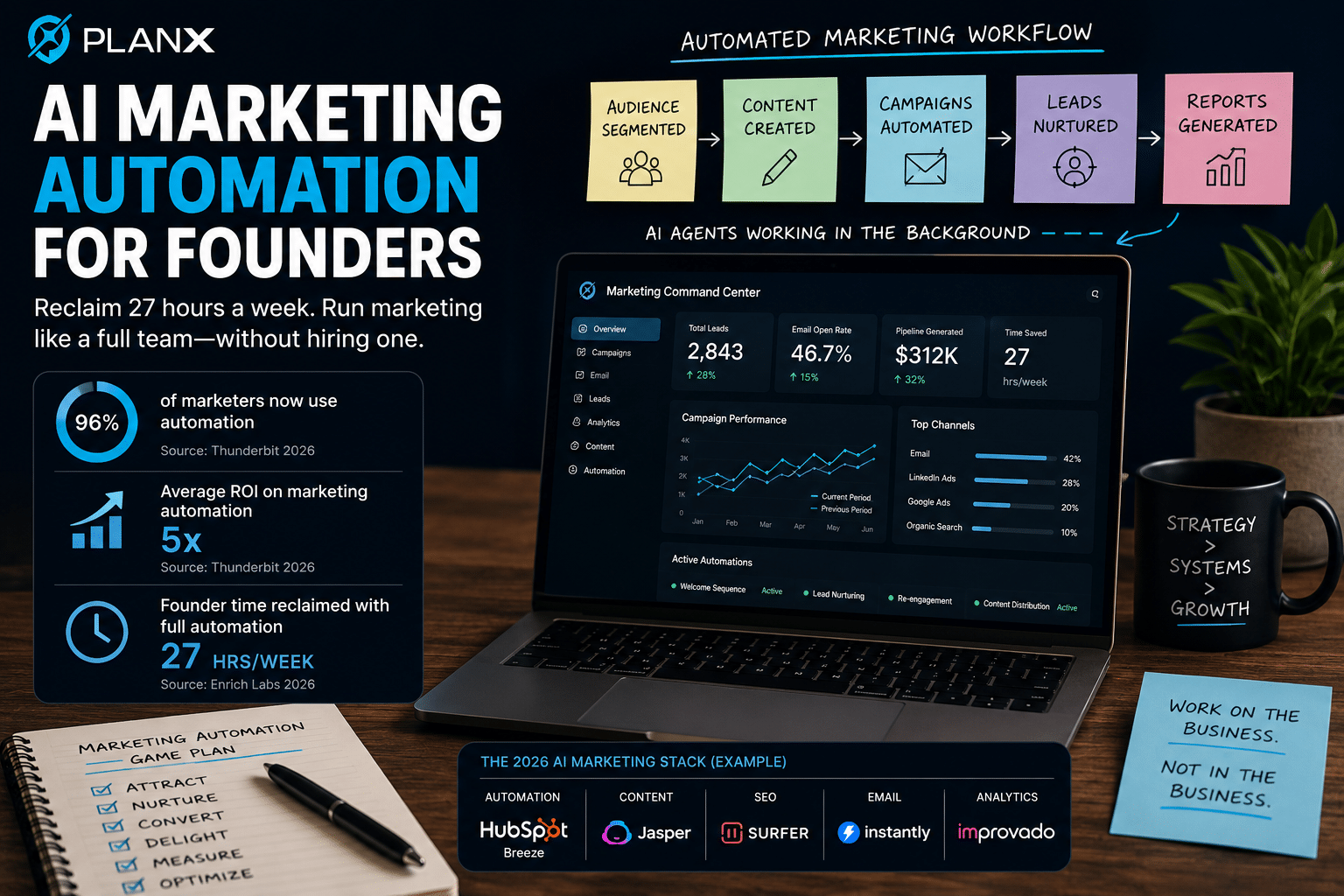
AI marketing automation uses artificial intelligence to run marketing workflows (email, ads, content, lead nurturing, reporting) with minimal manual input. In 2026, 96% of marketers use automation and report an average 5x ROI. For founders, full marketing automation reclaims roughly 27 hours per week, the equivalent of a full-time hire without the salary. The best 2026 tool stack combines an automation platform (HubSpot Breeze or Salesforce Agentforce), a content engine (Jasper or Claude), and channel-specific tools (Surfer for SEO, Reply.io for outreach). Most serious teams run 3 to 5 integrated tools, not one platform. Tool costs run $99 to $500 per month for startups. |
| AI Marketing Automation 2026: Key Facts
• Marketers now using marketing automation: 96% (Thunderbit 2026) • Average ROI on marketing automation: 5x (Thunderbit 2026) • Founder time reclaimed with full automation: ~27 hours/week (Enrich Labs 2026) • Annual recoverable opportunity cost from manual marketing: $84,240 (Enrich Labs 2026) • Time saved automating campaign management + reporting alone: 15 to 20 hours/week • Typical startup automation tool cost: $99 to $500/month • Tools in a typical serious marketing stack: 3 to 5 (not one platform) • Recommended all-in-one starting platform: HubSpot Breeze • Enterprise automation standard: Salesforce Agentforce + Einstein • 2026 frontier: autonomous ad agents managing Google, Meta, LinkedIn without humans |
 96% of marketers now use automation, reporting an average 5x ROI. For founders, the real prize is 27 hours a week reclaimed.
Most founders run marketing the hard way. You write the emails, brief the content, check the ad accounts, pull the reports, chase the leads, and somehow still feel like marketing is the thing you never have enough time for. You became a generalist stretched across every channel, executing everything at about 60% of what it should be.
Here’s the calculation most founders never sit down to run. Manual marketing execution costs roughly 27 hours per week of someone’s time. At a loaded cost of $60 per hour for a marketing manager, that’s $1,620 per week, or $84,240 per year, spent on tasks that AI can now handle. The best marketing automation tools cost between $99 and $500 per month.
AI marketing automation is how 7-figure founders close that gap. Not by replacing the marketing team, but by letting AI handle the high-volume, repetitive work so the humans focus on strategy, creative, and the few things that actually require judgment. This guide is part of our AI scaling pillar for 7-figure founders and covers exactly how to deploy AI marketing automation in 2026: the tools that work, the workflows that compound, the realistic ROI, and the mistakes that waste money.
No tool-listicle filler. No “AI will revolutionize marketing” hype. Just what works in 2026, what it costs, and how to deploy it in the right order.
| Is marketing actually your bottleneck?
Before you spend $500/month on marketing automation tools, find out if marketing is even your real constraint. The 2-minute Founder Bottleneck Quiz shows you where your business is actually capped right now. Built for founders past their first $1M. |
What is AI marketing automation?
AI marketing automation is the use of artificial intelligence to execute marketing tasks and workflows that previously required manual human effort. It goes beyond traditional automation (which follows fixed rules) by using AI to make decisions, personalize content, optimize timing, and adapt campaigns based on real-time data. In practice, it spans email marketing, ad management, content generation, lead scoring, customer journey orchestration, and analytics.
How it differs from traditional marketing automation
Traditional marketing automation follows pre-set rules. “If a lead downloads this ebook, send this email sequence.” Useful, but rigid. When conditions change, someone has to rewrite the rules.
AI marketing automation adapts. It decides which leads are worth pursuing based on patterns it learns from your data. It writes and tests variations of messaging. It optimizes send times per individual recipient. It reallocates ad budget across channels based on performance, automatically. The difference is between a system that executes your rules and a system that improves on them.
The 2026 shift: from automation to agents
The biggest change in 2026 is the rise of autonomous marketing agents. Tools now exist that manage entire ad accounts across Google, Meta, LinkedIn, and other platforms without human intervention. AI SDR agents run outbound pipeline. Content agents produce and distribute multi-format campaigns from a single brief. The frontier moved from “AI helps you do marketing tasks faster” to “AI runs the marketing function while you supervise.”
Why does AI marketing automation matter for founders in 2026?
AI marketing automation matters because it produces measurable ROI and reclaims founder time at a scale that wasn’t possible before. In 2026, 96% of marketers use automation and report an average 5x return. For founders specifically, full marketing automation reclaims roughly 27 hours per week, equivalent to hiring a full-time marketing manager without the $78,000 salary. The math is straightforward: tools cost $99 to $500 per month, and the time and performance gains are worth many multiples of that.
The ROI is documented
Per the Thunderbit 2026 Marketing Automation Statistics report, 96% of marketers now use marketing automation and the average return is 5x. This is no longer an emerging tactic. It’s the baseline expectation for any business competing seriously in 2026.
The time savings are specific
Per Enrich Labs’ 2026 startup automation guide, founders who fully automate marketing reclaim around 27 hours per week, which represents $84,240 per year in recoverable opportunity cost at a $60/hour loaded rate. Most teams save 15 to 20 hours per week just by automating campaign management and reporting, before touching content or lead generation.
For a 7-figure founder, the value isn’t only the time. It’s what you do with that time. 27 hours per week redirected from marketing admin to strategy, partnerships, product, or rest is the difference between a business that depends on you and one that scales beyond you.
What are the best AI marketing automation tools in 2026?
The best AI marketing automation tools in 2026 fall into five categories: all-in-one automation platforms (HubSpot Breeze, Salesforce Agentforce), content generation (Jasper, Claude, Copy.ai), SEO (Surfer, Semrush), email and outreach (Reply.io, Seventh Sense), and analytics (Improvado). Most serious teams use 3 to 5 integrated tools rather than one platform. The right stack depends on your biggest time sink, not on which tool has the most features.
All-in-one automation platforms
- HubSpot Breeze: The strongest all-in-one platform and the recommended starting point for most founders. Combines CRM, email, lead scoring, marketing automation, content, and reporting in one ecosystem. AI is embedded inside workflows tied to contacts and revenue, not bolted on. Best for growth-oriented B2B teams and service businesses.
- Salesforce Agentforce + Einstein: The enterprise standard. More complex and costly, but the right choice if you already run Salesforce, because it integrates natively with your existing CRM.
Content generation
- Jasper: Wins for brand-consistent long-form content at scale. Rewards investment. Light users won’t see ROI, so deploy it when you have real content volume.
- Claude and ChatGPT: Strong for content drafting, strategy, and analysis. Claude tends to be stronger for longer-form and analytical work. Both belong in most 2026 marketing stacks.
- ai: Good for shorter-form marketing copy, ad variations, and quick iterations.
SEO and content optimization
- Surfer SEO: Leads on-page SEO optimization. Pairs well with a content generator to produce search-optimized content at scale.
- Semrush: The broader SEO and competitive intelligence platform. Keyword research, rank tracking, competitor analysis, and content gap identification.
Email and outreach
- io: Multi-channel outreach automation. Good for founders running outbound sales-led marketing.
- Seventh Sense: Email send-time optimization. AI determines the best time to email each individual recipient, improving open and reply rates.
Analytics and reporting
- Improvado: Unified marketing analytics. Lets you query marketing data in plain English and generate dashboards and reports without SQL or manual work. Strong for founders who want data continuously available.
Autonomous ad management (the 2026 frontier)
- Autonomous ad agents: New in 2026, platforms that manage Google Ads, Meta Ads, LinkedIn, and other channels with minimal human intervention. Powerful but watch for over-automation. Keep a human reviewing spend and creative direction.
| The most important tool-selection rule in 2026
AI marketing tools differentiate through implementation depth, not feature lists. Every platform now offers content generation, analytics, and automation. The competitive advantage comes from choosing tools that integrate with your existing data and workflows. A tool that can’t connect to your CRM, CMS, analytics, and ad platforms leaves its value isolated. Always prioritize integration over feature count. |
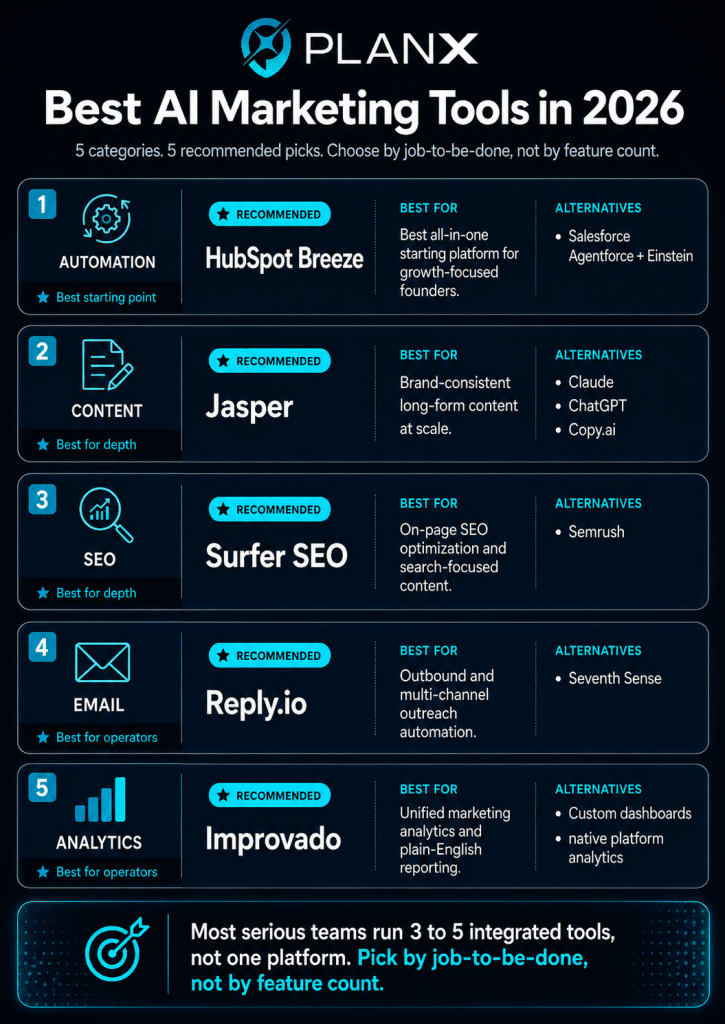 Most serious teams run 3 to 5 integrated tools, not one platform. Pick by job-to-be-done, not by feature count.
Which AI marketing automation workflows deliver the most ROI?
The highest-ROI AI marketing automation workflows for founders are: AI email nurture sequences, AI content production and repurposing, AI lead scoring and routing, AI ad campaign optimization, AI social media management, and automated marketing reporting. Ranked by speed to ROI, email nurture and reporting automation pay back fastest (within 30 days), while content and ad optimization compound over 60 to 90 days.
1. AI email nurture and lifecycle automation
The pattern: AI segments your list, personalizes messaging per contact, optimizes send times individually, and triggers sequences based on behavior. New subscriber gets one path, a stalled lead gets another, a churned customer gets a win-back sequence. All automatic, all personalized.
Why it pays back fast: email has the cleanest attribution of any marketing channel. You can measure the lift directly. Founders typically see open and reply rate improvements within the first 30 days, and the time savings (no more manual list management or campaign sends) are immediate.
2. AI content production and repurposing
The pattern: AI turns one piece of source content into 8 to 12 derivatives across formats. One blog post becomes a LinkedIn article, several social posts, an email newsletter, video clip scripts, and an SEO landing page variant. The human provides the strategic input and final review. AI handles the production and reformatting.
Why it compounds: distribution is the real bottleneck in content marketing, not creation. A founder producing one strong piece per week with full AI repurposing reaches what a team producing 8 to 12 pieces would reach manually. This is one of the highest-leverage workflows in the guide.
3. AI lead scoring and routing
The pattern: every inbound lead gets enriched with public data and scored against your historical conversion patterns. High-fit leads get prioritized and routed to sales within minutes. Low-fit leads get an automated nurture track. Your team stops wasting time on leads that were never going to convert.
Why it matters: founders report 25 to 40% improvement in sales team focus when AI handles lead qualification. Faster response to high-fit leads also captures the roughly 4x conversion advantage of responding in 5 minutes versus 24 hours.
4. AI ad campaign optimization
The pattern: AI monitors ad performance across channels and reallocates budget toward what’s working, automatically. It tests creative variations, adjusts targeting, and flags underperforming campaigns. In 2026, some platforms run this fully autonomously across Google, Meta, and LinkedIn.
Why it’s powerful but needs supervision: AI is excellent at optimizing within a channel. It’s less reliable at strategic decisions like which channels to be on or what the brand should say. Let AI optimize the execution. Keep humans on strategy and creative direction.
5. AI social media management
The pattern: AI drafts posts, schedules them at optimal times, monitors brand mentions and sentiment, and surfaces engagement opportunities. Some tools handle community response for routine interactions and escalate the rest.
Why it’s useful: social media is a time sink with unclear ROI for most founders. AI automation lets you maintain consistent presence without the daily time drain, freeing you to engage only where it matters.
6. Automated marketing reporting and analytics
The pattern: AI connects your marketing data sources, generates dashboards, surfaces anomalies, and writes plain-language summaries of what changed and why. No more manual report-building before every team meeting.
Why it pays back fast: reporting is pure overhead. Automating it returns 15 to 20 hours per week (combined with campaign management) and makes marketing data continuously available, which improves decision quality across the business.
| Which marketing workflow should you automate first?
The answer depends on where your specific bottleneck is. The 2-minute Bottleneck Quiz diagnoses where AI marketing automation will pay back fastest for your business. Built for founders past their first $1M. Free. |
What is the ROI of AI marketing automation, and how do you measure it?
The average ROI on marketing automation is 5x, per 2026 industry data. To measure it properly, track four metrics: tool ROI (revenue generated and costs saved versus tool cost), team efficiency (hours saved per person), lead quality (conversion rate before versus after AI), and customer acquisition cost (CAC with and without AI). If any metric stagnates after 2 to 3 months, investigate and optimize. The most common reason for poor ROI is buying powerful tools but failing to integrate them with existing workflows.
The four metrics that actually matter
- Tool ROI: Revenue generated plus costs saved, divided by tool cost. If a $300/month tool saves 15 hours/week of a $60/hour resource, that’s $3,600/month in time value against $300 in cost. 12x before counting any revenue lift.
- Team efficiency: Hours saved per person per week, tracked honestly. This is the easiest metric to measure and the hardest to fake. Track it.
- Lead quality: Conversion rate of leads before and after AI scoring. Tag AI-influenced leads in your CRM and compare against a baseline.
- Customer acquisition cost (CAC): Calculate CAC with and without AI-driven activities. AI should reduce CAC over time as it optimizes spend and improves targeting.
How to prove ROI in the first 90 days
Set a baseline before you deploy anything. Measure your current email open rates, lead conversion rates, hours spent on marketing admin, and CAC. Deploy one workflow. Measure the same metrics 30, 60, and 90 days later. The comparison against your documented baseline is your proof.
Per the tool-evaluation frameworks used by serious marketing teams in 2026, if any key metric (email response rate, lead quality, conversion rate) stagnates or declines after 2 to 3 months of implementation, that’s your signal to investigate the tool, the implementation, or the workflow design. Don’t let underperforming automation run on autopilot.
How should founders implement AI marketing automation?
Implement AI marketing automation in three phases. Phase 1 (Weeks 1-4): unify your data and automate reporting and email, the fastest wins. Phase 2 (Weeks 5-12): add AI content production and lead scoring. Phase 3 (Months 3-6): layer in ad optimization and social automation. The critical first step is data unification: AI marketing tools require clean, centralized data to work, and 67% of businesses have data too messy for AI to use effectively.
Phase 1 (Weeks 1-4): Unify data, automate reporting and email
- Audit where your marketing data lives and consolidate it (this is the unglamorous step that determines everything else)
- Deploy an all-in-one platform (HubSpot Breeze for most founders) or connect your existing tools
- Automate marketing reporting first (pure overhead, fast payback)
- Set up AI email nurture sequences (cleanest attribution, 30-day ROI)
Phase 2 (Weeks 5-12): Content and lead scoring
- Deploy AI content production and repurposing (highest leverage on distribution)
- Set up AI lead scoring and routing (25 to 40% improvement in sales focus)
- Integrate content tools with your SEO workflow (Surfer or Semrush plus a content engine)
Phase 3 (Months 3-6): Ads and social
- Layer in AI ad campaign optimization (keep human oversight on strategy and creative)
- Deploy AI social media management (consistent presence without the time drain)
- Consider autonomous ad agents only after you understand your channel economics
| The mistake that wastes the most money
Deploying AI marketing tools before unifying your data. AI analytics and personalization require clean, centralized customer data. Organizations without unified customer records and attribution frameworks should prioritize data integration before adopting AI analytics or personalization tools. Skip this and your expensive AI tools will produce inconsistent, unreliable output. Fix data first, always. |
What are the most common AI marketing automation mistakes?
The most common AI marketing automation mistakes are: deploying tools before unifying data, choosing tools by feature list instead of integration fit, over-automating without human oversight on brand and strategy, buying powerful platforms but never operationalizing them, and failing to measure ROI against a baseline. Each is preventable.
1. Tools before data
Covered above, but it’s the number one mistake so it’s worth repeating. Clean, centralized data first. AI tools second. The reverse order wastes money and produces garbage output.
2. Choosing by features, not integration
Every AI marketing tool in 2026 lists impressive features. The ones that deliver ROI are the ones that integrate with your CRM, CMS, analytics, and ad platforms. A standalone tool with the best features but no integration leaves its value trapped. Always evaluate integration first.
3. Over-automating brand and strategy
AI is excellent at execution and optimization. It’s unreliable at brand voice, strategic positioning, and creative direction. Founders who fully automate these get generic, off-brand marketing that slowly erodes their differentiation. Automate the execution. Keep humans on strategy, brand, and creative.
4. Buying platforms but not operationalizing them
Many teams buy strong automation platforms and still struggle to see impact. The platform isn’t the point. The workflows you build on it are. Buying HubSpot and using 10% of it is worse ROI than buying a cheaper tool and using all of it. Operationalize what you buy.
5. No baseline, no measurement
If you don’t measure your marketing metrics before deploying AI, you can’t prove the AI worked. Set baselines. Measure at 30, 60, 90 days. Optimize what underperforms. Most founders skip this and end up unable to tell which tools are worth keeping.
Frequently Asked Questions
What is AI marketing automation?
AI marketing automation is the use of artificial intelligence to run marketing tasks and workflows (email, ads, content, lead nurturing, reporting) with minimal manual input. Unlike traditional automation that follows fixed rules, AI marketing automation makes decisions, personalizes content, optimizes timing, and adapts campaigns based on real-time data. In 2026, 96% of marketers use it with an average 5x ROI.
How much does AI marketing automation cost in 2026?
For startups and small businesses, the best marketing automation tools range from $99 to $500 per month. All-in-one platforms like HubSpot Breeze scale with contact count and feature tier. Most serious teams run 3 to 5 tools, so a realistic total marketing automation stack costs $300 to $1,500 per month depending on scale. Against a documented $84,240 per year in recoverable opportunity cost from manual marketing, the ROI math is straightforward.
What’s the best AI marketing automation tool for founders?
For most founders, HubSpot Breeze is the recommended starting point because it combines CRM, email, lead scoring, automation, and reporting in one ecosystem with transparent pricing. If you already run Salesforce, Salesforce Agentforce + Einstein makes more sense for native integration. As you scale, add specialized tools: Jasper or Claude for content, Surfer or Semrush for SEO, Reply.io for outreach. Most serious teams use 3 to 5 integrated tools, not one platform.
What ROI can I expect from AI marketing automation?
The average ROI on marketing automation is 5x, per 2026 industry data. Founders who fully automate reclaim roughly 27 hours per week (worth around $84,240 per year at a $60/hour loaded rate). Most teams save 15 to 20 hours per week from automating campaign management and reporting alone. Actual ROI depends on implementation quality and how well your tools integrate with existing workflows.
Will AI marketing automation replace my marketing team?
No. AI marketing automation replaces repetitive tasks, not marketing judgment. The teams winning in 2026 use AI for high-volume work (content production, reporting, list management, send-time optimization) while humans handle strategy, brand voice, creative direction, and relationship-building. Founders who fully automate brand and strategy end up with generic, off-brand marketing. Automate execution, keep humans on judgment.
Can a solo founder run marketing with AI automation?
Yes. This is one of the strongest use cases. A solo founder with a well-built AI marketing stack can run email, content, social, and reporting at a level that previously required a small team. The key is starting with the right foundation (unified data, one core platform) and adding workflows in order rather than buying 10 tools at once. Expect to reclaim 15 to 27 hours per week.
What’s the difference between marketing automation and AI marketing automation?
Traditional marketing automation follows pre-set rules: if X happens, do Y. It’s rigid and requires manual rule updates when conditions change. AI marketing automation adapts: it learns from data, personalizes per individual, optimizes timing and budget automatically, and improves over time. Traditional automation executes your rules. AI automation improves on them. In 2026 the line is blurring as most platforms add AI layers.
How do I measure the ROI of AI marketing automation?
Track four metrics against a baseline you set before deploying: tool ROI (revenue plus cost savings versus tool cost), team efficiency (hours saved per person), lead quality (conversion rate before versus after AI), and customer acquisition cost (CAC with and without AI). Measure at 30, 60, and 90 days. If any metric stagnates after 2 to 3 months, investigate the tool, implementation, or workflow design.
What should I automate first in my marketing?
Start with your biggest time sinks. For most founders that means marketing reporting (pure overhead, fast payback) and email nurture sequences (cleanest attribution, 30-day ROI). Audit where your marketing team spends the most manual hours, then automate the highest-effort, lowest-value tasks first. Most teams save 15 to 20 hours per week just from automating campaign management and reporting.
Do I need clean data before using AI marketing tools?
Yes, this is critical. AI analytics and personalization tools require clean, centralized data to work. 67% of businesses have data too messy for AI to use effectively. Organizations without unified customer records and attribution frameworks should prioritize data integration before adopting AI analytics or personalization tools. Deploying AI on messy data produces inconsistent, unreliable output. Fix data first.
Are autonomous AI ad agents worth it in 2026?
They’re powerful but require informed supervision. New in 2026, autonomous ad platforms manage Google, Meta, LinkedIn, and other channels with minimal human intervention. They optimize execution well (budget allocation, creative testing, targeting adjustments). They’re less reliable on strategic decisions like channel selection and brand messaging. Use them only after you understand your channel economics, and keep a human reviewing spend and creative direction.
When should I attend an AI conference vs just building my marketing stack?
Reading guides like this teaches you frameworks. Conferences compress months of vendor evaluation, peer learning, and implementation troubleshooting into 2 days. The math: a 1-hour conversation with a founder who built the exact marketing stack you need is worth more than 50 hours of independent research. PlanX 2026 pairs 7-figure founders with the AI marketing specialists and operators who have already deployed what you’re trying to build, in a dedicated Leverage track focused on AI and automation.
Where founders learn AI marketing automation in person
Reading guides teaches you the frameworks. Building a marketing automation stack that actually compounds requires conversations with founders who’ve done it, and specialists who can troubleshoot your specific situation.
PlanX 2026 is the 2-day founder conference in Dubai built for operators scaling past 7 figures, with a dedicated Leverage track covering AI marketing automation, AI workflows, and operational systems. November 25 to 26 at Grand Hyatt Dubai. 2,500 founders. 40+ speakers. Three tracks: Growth, Leverage, Network.
The Leverage track is where founders share the exact marketing stacks they’ve built, what’s producing ROI, what’s overhyped, and what 2026 changed. Tactical and current, not theoretical.
| Lock in PlanX 2026 tickets
Super Early Bird Global Access at $299 (50% off, available May to June). Limited Offer with 2 nights at Grand Hyatt at $698 (only 150 units total). Sovereign VIP with private yacht after-party at $599 Super Early Bird. |
Going deeper: the complete AI scaling library
This guide is part of the PlanX AI scaling library. Each piece connects to the next:
- Start with the strategic framework: Scaling with AI: The 2026 Playbook for 7-Figure Founders (the pillar guide).
- Build the operational layer: AI Workflows for Founders, 12 automation patterns that return 15+ hours a week.
The bottom line on AI marketing automation in 2026
The opportunity is clear and measurable. 96% of marketers use automation. The average return is 5x. Founders who deploy it fully reclaim around 27 hours per week, worth $84,240 per year in recoverable time, against tool costs of a few hundred dollars per month.
The catch is that the ROI comes from implementation, not from buying tools. The founders who win unify their data first, choose tools that integrate with their existing stack, automate the highest-effort lowest-value tasks first, keep humans on brand and strategy, and measure everything against a baseline.
If you’re serious about this, start simple. Take the Bottleneck Quiz to confirm marketing is your real constraint. Unify your data. Deploy reporting and email automation in the first month. Add content and lead scoring in the second. Layer in ads and social by month three. Measure as you go.
The tools are ready. The ROI is documented. The only question is whether you deploy it deliberately or keep running marketing the hard way.
| Start with the diagnosis
The 2-minute Founder Bottleneck Quiz tells you whether marketing automation is your highest-ROI move right now, or whether your real bottleneck is somewhere else. Built for founders past their first $1M. Free. |